Blog
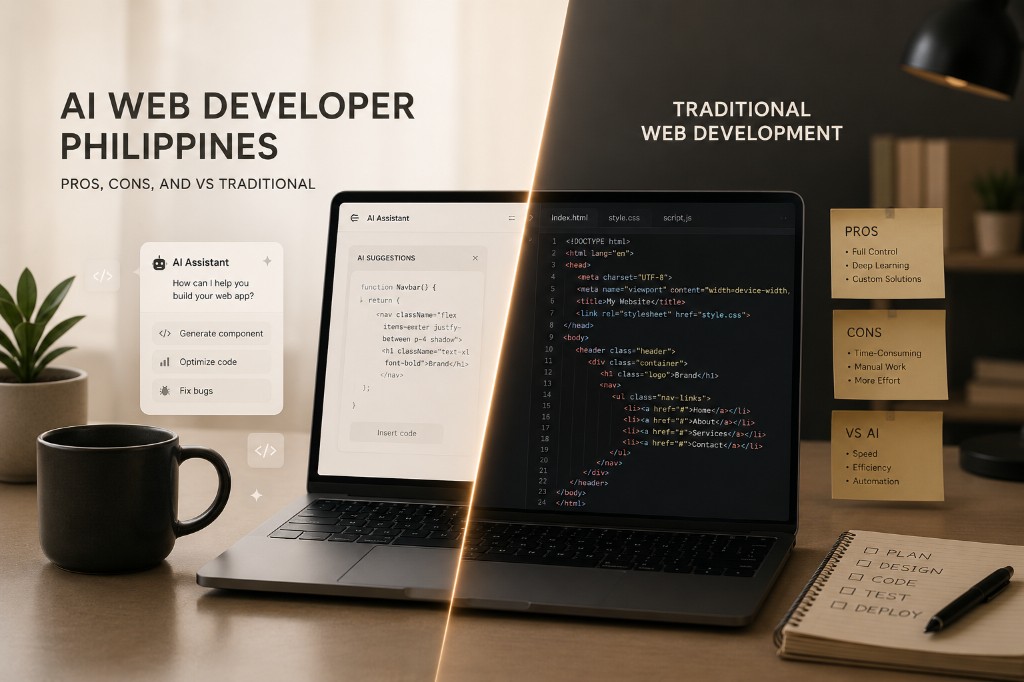
AI web developer Philippines — pros, cons, and vs traditional web dev
For founders and agencies hiring in the Philippines — AI web dev vs traditional, with pros, cons, red flags, and when each model actually fits.
Clients in the Philippines keep asking: should we hire an AI web developer or a traditional one? Usually what they mean is: Will it be cheaper? Faster? Generic? Secure? Will we regret it in six months?
I'm not selling "AI builds your website while you sleep." I'm a production mobile and web developer — delivery, ride, booking, commerce, photo contests, member portals — who uses Cursor and Claude to move faster on product features, admin tools, and custom web builds. See my work and about page for the full picture.
Who this is for: founders, SMB owners, and agency leads comparing AI-augmented vs traditional web delivery — and developers who want the hiring side of the story, not tool hype.
Same accountability as a traditional web developer. Different workflow.
This post answers those client questions honestly — pros, cons, when traditional delivery still wins, and how to spot the wrong fit early. For delivery, see AI engineer and web development.
A real scope (content-heavy pages, not magic)
A typical product brief: an SMB needs five to ten structured pages — services, locations, FAQs — all matching one template and internal link structure. Traditional hand-build works; it just takes longer to get the first complete draft in front of stakeholders. With AI-augmented workflow, I draft structured pages faster, then align structure, links, and tone in review before anything goes live. On this portfolio, I used the same pattern for /services/ and /expertise/ pages. Same deliverable — shorter loop on content-heavy scope, not a different standard of care.
What each role actually means
Let's kill the straw man first.
Traditional web developer — hand-delivers sites and apps with established stacks: PHP, HTML/CSS, JavaScript, sometimes React. Estimates manually, codes manually, owns maintenance. No AI in the pitch, or uses it quietly without making it the brand.
AI-augmented web engineer (how I describe myself) — same deliverables, but embeds LLM tools into the workflow: rules in the repo, skills for recurring tasks, small diffs, human review before deploy. Still ships booking portals, admin tools, React products, PHP APIs. Still signs off on security and launch.
The difference is how work gets done — not whether a human owns the release.
| Traditional web developer | AI-augmented web engineer | |
|---|---|---|
| Sells | Sites, maintenance, integrations | Same — plus workflow speed and modern product AI when needed |
| Typical stack | PHP, JavaScript, established CMS or custom front ends | Same — AI doesn't replace the stack clients need |
| Client fear | "Slow / expensive" | "Generic slop / insecure / unmaintainable" |
| Your job as hirer | Judge portfolio and references | Judge portfolio and whether they review AI output like a senior dev |
An AI web developer who never reads the diff is not a new category — they're a risk. A traditional developer who refuses any modern tooling may be slow on boilerplate. You're hiring a person and a process, not a buzzword.
I use AI web developer in titles and search, and AI-augmented engineer when describing the workflow — same person, same release accountability.
Pros of AI-augmented web development (for clients)
Here's what that looks like for clients — outcomes, not tool hype.
1. Faster time to first draft
Landing pages, service page templates, component shells, FAQ blocks, meta descriptions — AI accelerates the first 60% when you already have rules and a design system. This portfolio and its service and expertise pages were built that way: AI drafts, I review, then push.
2. Cheaper iteration on content-heavy work
Need five FAQ variants, ten city pages, or three hero copy directions? Iteration is cheaper in time, not necessarily in invoice — good developers charge for judgment and release, not keystrokes.
3. Consistency at scale
Project rules and skills keep new pages matching existing patterns — naming, components, internal links, tone. That matters when you're adding /services/ and /expertise/ pages without each one drifting into a different template. See my React Native post for the same discipline on a new stack.
4. Better handoff artifacts
README sections, API notes, content briefs, checklists — AI helps document what shipped. Clients and agency partners get clearer handoffs.
5. Stronger positioning in a crowded market
"Web developer Philippines" is crowded. AI-assisted web development with senior review is a narrower lane — startups, agencies burned by vibe-coding, and product owners who want LLM features without hiring a research lab.
6. Product AI on real builds
When the site or app is the AI product — roadmaps, chat, suggestions, matching — you need someone who's shipped that layer. SolverIQ on my work page is one live booking-style product (paid sessions for Ideyator Ventures; solveriq.com). The same scheduling patterns apply to salon, laundry, and other appointment apps — different catalog, same calendar core.
Cons and honest limits (read this before you hire)
This section is why clients trust me. Skip it and you're buying hype.
1. Security doesn't autocomplete
AI will write vulnerable PHP, loose auth checks, and SQL you shouldn't run. Native PHP backends need the same human security pass as always — prepared statements, session hygiene, env-based secrets.
2. Thin content needs a product goal
AI-generated copy needs intent mapping, structure, internal links, and a clear product goal behind the page. I build web products — booking flows, member portals, commerce admin — the same domains as my mobile work: delivery, ride, logistics, booking, and e-commerce.
3. Wrong stack recommendations
"Rebuild everything in Next.js" when plain PHP gets you to market in three weeks is a failure of judgment, not a win for AI. I say that openly on web development services — React is a growing skill I build through real projects; PHP is production depth on backends and admin.
4. Hidden technical debt
Duplicate components, unused dependencies, inconsistent patterns — huge unreviewed diffs compound fast. Small diffs + review is the fix, not turning AI off.
5. Price misconception
Clients expect 50–90% off because "the robot wrote it." Reality: you pay for architecture, review, release, information architecture, and liability. Throughput goes up; accountability doesn't disappear.
6. Maintenance six months later
AI doesn't own the repo when plugins break or the client needs a new payment gateway. Someone who understands the codebase does.
Bottom line: the con isn't AI — it's hiring someone who treats AI as a substitute for experience.
How AI + manual review resolves those cons
The cons above are real when AI runs without a gate. They shrink fast when you pair AI with manual code review, validation checks, and the same release habits you'd expect from a senior developer who never touched an LLM.
This is the workflow I use on mobile backends, booking flows, and this portfolio — not theory.
Security → human security pass, every time
AI drafts PHP, auth, and SQL fast. It also drafts the foot-guns. Before merge I walk the diff for prepared statements, session boundaries, env-based secrets, and anything that shouldn't hit a client app. Same pass I'd run on hand-written code — AI just got me to the review point quicker. See PHP without a framework for what that review actually looks like.
Thin content → intent mapping + structure review
AI spits out paragraphs. I map each block to a product goal: who reads it, what they do next, which page it links to. Structure, internal links, and tone get a human pass so pages read like a product, not a template farm. Draft speed from AI; judgment on what ships from me.
Wrong stack → architecture decision before the prompt
I pick the lane before asking AI to scaffold — plain PHP when the team already runs it, React when the product needs it, Cordova when stores are the target. AI doesn't get to rewrite the stack in one PR. If the recommendation doesn't match timeline and who maintains it, it doesn't merge.
Technical debt → small diffs + validation
Huge unreviewed diffs are how duplicate components and mystery dependencies appear. I keep changes small, read them line by line, and run what the project already has: typecheck, lint, build, and a quick smoke test on the path that changed. AI proposes; validation and review accept or reject.
Price misconception → you're paying for the gate, not the tokens
Throughput goes up with AI. Accountability doesn't. Clients pay for architecture, review, release, and someone who answers when production breaks — whether the first draft came from Cursor or a blank file. The combo doesn't mean discount pricing; it means fewer round-trips to get something reviewable on the table.
Maintenance → documented handoff + code you can still read
AI doesn't own the repo at month six. I do — or the client's team does, with README notes, clear module boundaries, and diffs small enough that the next developer isn't archaeology hunting. Review isn't only "does it work today"; it's "can we change this safely next quarter."
What validation actually means in practice
On a typical release pass, manual review covers:
- Logic — edge cases, null paths, wrong assumptions in API contracts mobile apps depend on
- Security — auth, input handling, secrets, store rules if it's a mobile build
- Regression — does the changed path still match the rest of the codebase
- Tooling — lint, typecheck, build, and run on device or browser when the change touches UI or APIs
- Tone and structure — on content-heavy pages, does it sound like one product voice
AI handles the first draft. Review and validation handle what clients actually run.
That's how the comparison table should be read: not "AI vs traditional," but AI-augmented with senior review vs traditional — both can ship safely; one gets to draft faster when the process is disciplined.
Red flags when hiring (either model)
Walk away or dig deeper if you see:
- No review story — they can't explain how AI output gets checked before production.
- Scope-free cheap quotes — "unlimited pages" because AI is fast usually means no review gate.
- No real portfolio — only template demos or screenshots with no live URLs you can click.
- Stack churn — pushes a full rewrite (e.g. Next.js) without tying it to timeline, budget, or who maintains it.
- Can't explain a shipped project — if they can't walk you through one live build end to end, assume they won't own yours either.
These apply to traditional developers too — AI just makes bad habits faster.
When a traditional web developer still wins
Be fair. Credibility matters.
Hire traditional delivery when:
- Scope is fixed and small — brochure site, no workflow discussion, existing agency relationship.
- Legacy PHP — extending what exists beats greenfield AI scaffolding.
- Zero-AI policy — compliance, enterprise procurement, or client culture.
- Pure craft — bespoke design implementation where AI only assists assets, not architecture.
- "Just fix my site" — no rules, no skills, no process setup; you need a wrench, not a methodology lecture.
My lane: custom mobile and web products — delivery apps, booking platforms, member portals, photo contests, PHP APIs behind live apps. AI-augmented product development when scope fits.
AI web developer vs traditional — quick comparison
| Factor | Traditional | AI-augmented (with senior review) |
|---|---|---|
| Best for | Small fixed scope, zero-AI policy, legacy PHP | Many service pages, product AI features, team Cursor setup |
| Client fear | Slow / expensive | Generic slop / insecure / unmaintainable |
| What you're buying | Craft + maintenance | Craft + review discipline + faster drafts |
| Proof to ask for | Live URLs, references | Live URLs + how they review AI output before deploy |
Hire me when you want reliable mobile and web product delivery — booking, delivery apps, portals, PHP APIs, React where it fits — plus faster iteration without skipping review. You're not paying for tokens. You're paying for fewer surprises at launch.
Who should hire which
Hire a traditional web developer if:
- Budget is minimum viable and scope won't grow.
- You already have an agency and only need implementation hours.
- You don't want AI mentioned in the process.
Hire an AI-augmented web engineer if:
- You need many landing or service pages with consistent structure.
- You're building a product with AI features in the UI or API.
- You want faster delivery but can't afford reckless speed.
- You're an agency that wants Cursor rules and review checklists for the team.
Hire me specifically if you need mobile + web + PHP in one picture, honesty about production vs growing skills, and public proof on work and in these blog posts — not claims without process.
What I actually do on web projects
Same pattern as my other AI posts — concrete steps, not abstract "leverage."
- Scope and product intent — who it's for, what it does, what ships on day one. Not "build me a website."
- Pick the lane — custom product web vs PHP API behind a mobile app vs admin portal paired with Cordova.
- Rules before big diffs — stack, naming, security bans, minimal-diff policy in the repo.
- AI for drafts — components, copy blocks, meta, FAQs, internal link suggestions.
- Human review — security, performance, accessibility, regressions, tone.
- Launch and handoff — what the client or agency owns next.
This portfolio is the case study: Next.js/React, service and expertise pages, blog — AI-assisted, human-reviewed before every push.
Pricing and expectations (short)
- AI doesn't mean half price. It means better throughput on defined scope.
- You should expect to pay for: architecture, review, release, information architecture, integrations, and production sign-off — whether the developer uses AI or not.
- Be wary of quotes that assume: unlimited pages or features because "AI is fast" — that usually means review got cut, and that's how you get slop and regret.
If a quote feels too cheap to include review, it probably doesn't include review.
FAQ
Should I hire an AI web developer or a traditional web developer?
Hire traditional when scope is small, fixed, and you already have an agency lane — maintenance on existing code, no AI policy, or "just fix my site." Hire AI-augmented when you need faster drafts on many pages, product AI features, or team workflow setup — with a senior human still owning review and release. This whole post is the longer answer; for delivery, see web development or AI engineer.
Is an AI web developer cheaper?
Usually no on invoice — you pay for judgment, architecture, review, and liability. Where AI helps is throughput: more landing variants, page drafts, and scaffolding in the same timeline. If a quote is suspiciously cheap, ask what review step got skipped.
Is AI-generated website code secure?
Only if a human security pass is part of the process. AI will write loose auth, bad SQL, and secrets in the wrong places. I treat AI output as draft until reviewed — same rule on PHP backends and mobile work. Combining AI with manual review and validation (lint, build, contract checks, smoke tests) is what turns "insecure by default" into "draft fast, ship carefully."
Can AI fix its own cons?
Not alone. AI plus manual code review and validation is what addresses generic output, security gaps, and hidden debt — the model drafts, a senior developer reads the diff, runs checks, and signs off. Without that gate, the cons in this post stay cons. With it, most become managed risks with faster time to first draft.
Do you use AI on client projects without telling them?
I'm upfront about using AI-assisted workflow when it's relevant. Clients hire outcomes — live products, integrations, stable releases — not keystrokes. What matters is that you sign off on what ships and that I don't paste unreviewed code into production.
Custom React or PHP API for an AI-augmented build?
Depends on budget, timeline, and who maintains it after launch. Custom React and PHP fit products — booking, portals, contests, mobile backends. I'll recommend the stack that matches your product, timeline, and team — see web development and full stack PHP.
How this fits my other posts
- React Native from zero — learning a new stack with rules and skills.
- PHP mini backend with AI — deepening a production stack without pretending frameworks don't exist.
- This post — hiring lens for web clients comparing AI-augmented vs traditional delivery.
Same rule everywhere: fast drafts, careful release.
Belief I'll stand on: AI changes how fast you get a draft — not who answers when something breaks in production.
Where to go next
- Web products — booking, portals, contests, React: web development Philippines
- Team workflow — rules, skills, production review: AI engineer Philippines
- Backend-heavy builds — PHP APIs, admin, mobile backends: full stack PHP
- Mobile production — Framework7/Cordova on live platforms: mobile app development
Comparing AI-augmented vs traditional for your project? Get in touch — mobile and web product development with review before release.